Sample · The Kinsale Chronicles, Book 1
The Kinsale Correspondent
Read the whole of Chapter One, right here.
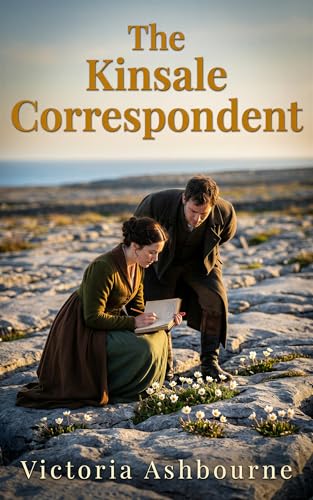
He crossed the sea to meet the brilliant botanist who signed himself E. M. Connell. He found a red-haired widow.
Clean, slow-burn Regency romance. Every book stands alone with a happily ever after.
New to Ireland? Keep the Irish words and the Kinsale map open beside you.
Chapter One
In which Mr. Doyle arrives by mail coach, forms several confident opinions, and is not yet wrong about any of them
The mail coach from Cork deposited Mr. Edmund Doyle in Kinsale at half past two on a Tuesday in late April, along with a leather trunk, a wooden specimen case reinforced at the corners with brass, and a thorough soaking that owed less to rain than to the particular disposition of the road south of Ballinspittle, which had decided, at the worst possible moment, to become a river.
He stood on the quayside and looked at the town.
It was smaller than he had expected. Cork had been smaller than he had expected. Ireland, in general, appeared to be conducting a campaign of disappointment against him, one modest revelation at a time, beginning with the crossing from Holyhead and proceeding steadily through every coaching inn between Dublin and here. Edmund had been at sea a great deal for the Society—the Azores, the Scottish islands, a miserable fortnight in Lapland—and he had believed himself a man of flexible expectations. He was revising that belief now, standing in his wet coat, watching a brown dog trot purposefully over the cobbles as though it had somewhere important to be.
The town arranged itself around the harbour with what he could only describe as an air of cheerful indifference to arrangement. The streets climbed the hill behind him in no particular order. The buildings presented a variety of colours—cream, ochre, a rather assertive pink—that would have been vulgar in London and was here merely emphatic. The estuary opened before him, grey-green, edged with mudflats where the tide was going out, and above everything the sky was doing what Irish skies apparently did, which was to cycle through three weather systems before he had time to form a considered view of any of them.
He was twenty-eight years old, a Fellow of the Linnean Society, a corresponding member of the Royal Society, and the author of two well-regarded monographs: one on the cliff flora of the Pembrokeshire coast, one on the bog plants of the Somerset Levels. He had been sent here by the Royal Society to complete what ought to have been a simple commission: to document the limestone flora of the Burren, with attention to those species found nowhere else in the British Isles, and to credit properly the work of the Society's most remarkable Irish correspondent, one E. M. Connell, whose letters on the subject had been, over the past three years, the most interesting botanical communications Edmund had received.
He had never met E. M. Connell. Nobody at the Society had. Connell corresponded reliably—four times yearly, more often when something wanted noting—but had never come to London for the meetings, had declined the invitation to contribute a lecture, and had a habit of deflecting personal enquiries with a dryness that Edmund, who was himself a fairly dry person, had found oddly companionable at a distance. He knew that Connell was based in Kinsale, was connected in some way to the local botanical community, and had a working knowledge of the Burren that no Englishman Edmund had encountered could match.
He also knew that he was here to document the Burren, and that Connell's papers—properly arranged, properly attributed, framed within a larger scientific narrative—would be the backbone of the Royal Society's publication. He had said as much in his most recent letter. Connell had replied with a note whose three sentences managed to convey polite agreement, mild amusement, and something Edmund had not quite been able to characterise, which now, standing on the quayside at Kinsale in a wet coat, he was inclined to characterise as patience.
He needed lodgings. He needed to find Connell. He needed, probably, dry stockings.
The postmaster's boy, who had carried Edmund's trunk to the quay with the air of someone conferring a great favour, was still hovering at a small but significant distance, which Edmund understood to mean that he had not yet been paid. He gave the boy sixpence, was rewarded with a grin of pure satisfaction, and asked about lodgings.
"Mrs. Hegarty has rooms," said the boy. "On Fisher Street. Or there's the inn on the square. Mrs. Hegarty's better, though. Quieter." He paused. "My aunt says Mrs. Connelly takes in lodgers sometimes, but she's particular."
Edmund looked up from his coat pockets, where he had been searching, fruitlessly, for his handkerchief. "Connelly?"
"Aye. Botanist woman. Up the hill." The boy pointed vaguely. "Doesn't take just anyone. Do you know plants?"
"I know a great deal about plants," said Edmund.
The boy looked at him with the measuring expression of someone who had heard a great many people claim expertise and had learned to calibrate his response accordingly. "She'll decide that for herself," he said. "Take the lane past the church, turn left at the wall with the yellow lichen—that's Xanthoria, she says—and it's the white house at the end."
Edmund stared at him. "She taught you that?"
"She teaches everyone." The boy shrugged, as though this were entirely ordinary, and trotted off with his sixpence.
Edmund stood in his wet coat and looked up the hill.
The lane past the church was steep and smelled of gorse and recent rain. He found the wall with the Xanthoria—which was indeed a very fine colony of the lichen, bright as paint against the grey limestone—and turned left, and found the white house at the end of a short track bordered by rough grass in which, he noticed, there were at least four species of orchid coming into early leaf.
He slowed his pace to look at them. He crouched, set down the specimen case, and looked more carefully. The first was certainly Dactylorhiza fuchsii, the common spotted-orchid, common enough here he supposed. The second appeared to be Anacamptis morio, the green-winged orchid, which he would not have expected in quite this density this close to a house. The third—
The third was not anything he could immediately name.
Edmund sat back on his heels and frowned at it. The leaf pattern was close to Neotinea ustulata, the burnt orchid, which he had seen in chalk downlands in Wiltshire, but the leaves were broader, the rosette lower, and there was something about the arrangement of the spots—darker, more irregular—that did not match. He reached for his specimen case.
"I'd rather you didn't."
He looked up.
A woman stood in the doorway of the white house. She was perhaps thirty or thirty-two, red-haired, with the kind of face that registered precise attention rather than conventional expression—not unfriendly, but thoroughly occupied with observation, which Edmund recognised because it was what his own face did. She was wearing a practical dress of grey wool, a kerchief at her throat, and an apron that had escaped the attention of anyone who might have reminded her to remove it. She held a trowel in her right hand.
"The orchid," she said. "I'd rather you left it alone."
"It's an interesting specimen," Edmund said, which was the only defence he had that seemed worth offering.
"It's a rare specimen," she said, "which is precisely why it isn't to be dug up by anyone who happens to crouch next to it. Are you the man from the Royal Society?"
Edmund got to his feet. He was aware that he was damp, somewhat dishevelled, and had been caught crouching in her grass. He arranged himself into the posture of a Fellow of the Linnean Society. "I am. Mr. Edmund Doyle. I'm looking for lodgings, and the postmaster's boy mentioned—"
"He mentioned that I sometimes take in lodgers." She looked at him with the same measuring quality the boy had deployed, and with considerably greater sophistication. "Do you know what that orchid is?"
"I was in the midst of determining that when—"
"Take your time."
He looked down at it again. He had been right about the leaves. The broader rosette, the spot pattern. The slight glaucous quality to the leaf surface that he had not registered consciously but had felt as a kind of wrongness, a departure from the expected type. He thought about the Burren, about the unusual calcicole flora, about the half-dozen letters from E. M. Connell he had read before leaving London and could now recall with uncomfortable clarity.
"I don't know exactly," he said. "It's close to Neotinea ustulata but it isn't quite right. I haven't seen the flower. It could be a variety, or—" He stopped. One of Connell's letters had mentioned, almost in passing, an orchid near Kinsale that appeared intermediate between Neotinea ustulata and Neotinea maculata, the dense-flowered orchid, a combination that ought to be impossible outside the Mediterranean and which Connell had been tracking through two flowering seasons to be certain of the identification before publishing any claim.
"—or it could be something that hasn't been formally described yet," he finished.
The woman looked at him. Something shifted slightly in her expression.
"Come in," she said. "I'll put the kettle on."
Her name, she told him over tea in the kitchen—a kitchen that was also, evidently, a pressing room, a drying room, and a working library, shelves of botanical texts rising between bunches of specimens hung from the rafters—was Mrs. Rosaleen Connelly. Her husband, Mr. Connelly, had died four years ago of an inflammation of the lungs. She had continued the botanical work she had begun during their marriage and had, she said it simply, without any particular emphasis, continued to find it interesting.
Edmund looked at her across the kitchen table and said, "And do you correspond with any of the learned societies? The Linnean, or the Royal?"
"I correspond with various people," she said, pouring his tea. "Milk?"
"Please." He took the cup. "I ask because I've had a most instructive correspondence with a botanist in Kinsale—a Mr. E. M. Connell—and I hoped you might know—"
"E. M. Connell," she repeated.
"Yes. Connell, not Connelly—I had assumed—"
"Had you," said Mrs. Connelly.
There was a pause. A very particular kind of pause.
Edmund set down his cup.
He was, he would reflect later, not a slow man. He had been slow here, but he would attribute that to the crossing, the rain, the coach road, and the perfectly reasonable assumption—shared by every man at the Royal Society, and it should be said that the Royal Society was, at this time, composed entirely of men—that E. M. Connell was a Mr. E. M. Connell. The initials E. M. He had not asked. Nobody had asked. It had not, in three years of correspondence, occurred to any of them to ask.
"Mrs. Connelly," he said. "You are E. M. Connell."
"Connell was my mother's name," she said pleasantly. "I find it useful."
"You have been corresponding with the Royal Society for three years—"
"Three and a half. Your secretary is sometimes slow to reply."
"—and nobody knew—"
"I did not advertise it. The letters were read or they were not. The work was sound or it was not. I thought it better to let the work speak first and the name later, or never." She looked at him steadily. "The orchid you were looking at this morning is a hybrid I have been tracking since the spring of 1811. My notes are in the second folder on the third shelf, if you'd like to look at them."
Edmund looked at the third shelf. He looked back at Mrs. Connelly. He was a man who prided himself on equanimity in the face of the unexpected—the sea had given him that, at least—and he drew on that equanimity now.
"I would very much like to look at them," he said.
"Good." She rose and took down the folder. "And the room is two shillings a week, coals extra. You may put your specimen case in the hall."
Want to know what happens next?
Keep reading on Amazon. The Kinsale Correspondent is in Kindle+.
Keep reading on AmazonOr start with a free Christmas novella, sent to your inbox.
Get the free novellaExcerpt from The Kinsale Correspondent by Victoria Ashbourne. © 2026 Victoria Ashbourne. All rights reserved.