Free sample · Winterwood Abbey, Book 1
Whispers at the Winter Retreat
Read the whole of Chapter One free, right here.
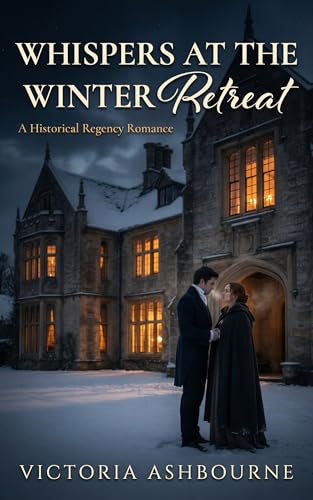
Snowed in for a month in a grieving baron's library. She was only meant to be useful.
Clean, slow-burn Regency romance. Every book stands alone with a happily ever after.
Chapter One In which Miss Penelope Thorne learns they are to go north, and begins to prepare for it
The invitation arrived on a Thursday, which was, in Penelope’s estimation, entirely the wrong day for catastrophe.
Thursdays were, by long-established custom, the day she sorted Lady Beatrice’s correspondence into three categories: letters requiring an immediate and effusive reply, letters requiring a polite reply within the fortnight, and letters that required only a quiet burial in the bureau’s lowest drawer. It was a task that occupied perhaps twenty minutes of real effort, the remainder being a performance of busyness intended to justify her continued presence in the morning room while Lady Beatrice conducted her toilette and complained about her hair.
Penelope was halfway through the second category when Lady Beatrice swept in.
She was wearing the rose-pink wrapper she reserved for moments of domestic drama, which was to say she wore it rather often. Her fair hair was still in its morning arrangement — a cloud of escaped curls that the maid Agnes had given up containing — and her blue eyes held the particular brightness that signalled she had either heard something delightful or was about to say something imprudent. With Lady Beatrice, it was generally both.
“Penelope,” she said, in the tone of one about to confer a great favour. “We are going to Winterwood Abbey.”
Penelope set down the letter she was holding. “I beg your pardon, my lady?”
“Winterwood Abbey. In December.” Lady Beatrice settled herself into the armchair nearest the fire with a sigh of profound satisfaction. “Lord Alistair has sent the invitation personally. Well — his secretary has sent it, but the signature is Lord Alistair’s own, which is apparently significant, since he almost never signs anything himself. Lady Ashworth says he has not opened the Abbey to guests in three years at minimum.” She paused to allow this information to produce its intended effect. “We are among the first to be invited. Is that not marvellous?”
Penelope considered the word marvellous with the private scepticism it deserved. She was familiar with Lord Alistair Wyndham, Baron Wyndham, in the way that any careful observer of London society became familiar with figures who were spoken of more than they appeared. He was reclusive. He was rumoured to be in possession of one of the finest private libraries in England. He had a large estate in the north that sat cold and largely unvisited throughout the greater part of the year. His sister had died three years ago in a carriage accident that had also taken her husband, and Lord Alistair had not been the same since — though the various people who relayed this information all differed considerably on the question of what the same had previously looked like.
He was, in short, the sort of man who produced a great deal of conversation in rooms he did not occupy.
“Winterwood Abbey is in Northumberland,” Penelope said. The observation was entirely factual. She intended it as such.
“Yes.” Lady Beatrice waved this away. “Quite remote, I understand. But that is the point, Penelope. A winter retreat. There will be a small party — other guests, very select — and apparently the Abbey itself is magnificent, though rather cold. Lady Ashworth has been once and says the library alone is worth the journey, though you know Lady Ashworth and her enthusiasms.” She said this in the fond tone of someone who shared those enthusiasms completely, which was not accurate, but Lady Beatrice was generous with her fond tones. “Lord Alistair is Lord Wyndham’s heir, which is to say he is Lord Wyndham, since his father died four years past and there is no brother to speak of. He is not yet forty. He is unmarried.”
There it was.
Penelope did not say anything. She had long since learned that the strategic moment in a conversation with Lady Beatrice was not the one she opened but the one, several sentences later, where she paused to receive acknowledgment. The pause arrived now.
“It sounds like a very long journey,” Penelope said.
“Penelope.” Lady Beatrice looked at her with the patient expression of someone explaining that rain falls downward. “He is unmarried. He is a baron. He has a house the size of a small cathedral and nobody to share it with. He has invited a very small party of select guests to spend December with him at that house. I have been specifically included.” She leaned forward slightly. “Do you follow me?”
“I follow you, my lady.”
“Good.” Lady Beatrice sat back. “We leave in a fortnight. Agnes will need to begin the packing immediately — I shall want the blue velvet, obviously, and the new cream silk, and the fur-trimmed pelisse, and — Penelope, are you writing this down?”
Penelope was already writing it down.
She was, at twenty-eight, ten years Lady Beatrice’s junior and the more orderly of the two by a considerable margin, which was not a distinction she had sought so much as one she had been pressed into by necessity. She was the daughter of a country clergyman, which was to say she had been raised on good principles, modest means, and the habit of making herself useful. Her father had died when she was nineteen, leaving behind a small sum of money, a large sum of good advice, a collection of theological texts that no one wanted, and three daughters who were going to have to find their own way.
The two younger ones had managed to find suitable husbands before the money ran entirely out. Penelope had not. This was not for want of opportunity so much as want of inclination — she had been nineteen when the most promising prospect had revealed himself to be primarily interested in her as an economic solution rather than as a person, and she had found the distinction mattered to her more than she had anticipated. By the time she had finished thinking about it, she was twenty and the season had passed and her mother was looking at her with a particular expression that combined love with desperation in roughly equal parts.
She had become a lady’s companion instead. First to an elderly Countess who had valued her primarily for her legible handwriting and her ability to play piquet, and who had died three years later leaving Penelope a small but sufficient legacy and a genuine affection for the old woman’s irascibility. Then, after a period of careful consideration of her options, to Lady Beatrice Farnsworth — a widow of eight years, childless, sociable, scattered, and in genuine need of someone to manage what she described as the practical details of her existence.
Penelope managed the practical details. She managed the correspondence, the household accounts, the social calendar, the packing, the travel arrangements, the management of staff whom Lady Beatrice offended without meaning to, and the gentle steering of Lady Beatrice’s numerous schemes toward outcomes that would not embarrass them both. She was good at her work. She had been good at every work she had ever been given. She sometimes wondered, in the privacy of her own thoughts — which remained, eight years into this arrangement, essentially the only privacy she had — whether there was any work she might choose for herself, rather than receive.
She did not dwell on this.
“The blue velvet,” she said, making a note. “The cream silk. The fur-trimmed pelisse.”
“And the green morning dress,” Lady Beatrice added. “The one with the — you know the one.”
“I know the one.”
“And my good riding boots, in case there is riding, though if it is as cold as they say there likely will not be, but one likes to be prepared.”
“Yes.”
“And Penelope—” Lady Beatrice’s voice shifted to the tone that preceded either a confidence or a request for a favour, and the two were rarely distinguishable until you were already committed. “I should like you to look your best as well. I know you will say it is not your concern, but it reflects on me, you know, how you present yourself. And Lord Alistair is, I believe, a man who notices things.”
Penelope continued writing. “I will attend to it, my lady.”
“The grey wool is all very well for London but it does rather make you disappear. Is there not something with a bit more— I am thinking of the russet. You wore it last November at the Pembletons’ and Captain Ashworth said you looked remarkably well.”
“Captain Ashworth says that sort of thing to everyone.”
“He does not,” Lady Beatrice said, with the authority of one who had tested this extensively. “He was quite particular about the russet.” She studied Penelope for a moment with the affectionate appraisal of a woman who has always had the luxury of being decorative and genuinely cannot conceive of someone choosing otherwise. “You have very good colour when you make the effort, Penelope. That auburn hair is quite striking, when it is not pinned into submission.”
“I shall pack the russet,” Penelope said.
“Excellent.” Lady Beatrice rose, apparently satisfied with both the wardrobe question and the conversation, which had, in her view, gone very well. “I am going to write to Lady Ashworth at once. She will want to know we have been invited. She will be terribly envious.” She said this with the serene pleasure of someone who has had few enough occasions for the emotion and now finds it on the other foot. “Oh, and Penelope — please do ask Mrs Harding about the state of my travelling case. I believe the latch is bent.”
“I will see to it.”
The door closed. The morning room settled back into its usual quiet — the fire, the tick of the mantel clock, the distant sound of Agnes on the stairs. Penelope looked down at her list. Blue velvet. Cream silk. Fur pelisse. Green morning dress. Riding boots. Russet. Travelling case latch.
She added, in smaller letters beneath: Reference atlas — Northumberland roads. Temperature in December.
Then she set down the pen and sat for a moment, not quite looking at anything.
Northumberland in December. A remote estate. A small party of guests. A reclusive host who had not invited anyone for three years and had now apparently changed his mind.
The practical aspect of her mind was already running through the list of what would need to happen: the correspondence to be managed, the packing to be supervised, the journey to be arranged, the household to be put in order for their absence. There was a great deal to do in a fortnight.
The other part of her mind — the one she generally kept quite busy, so that it did not have the leisure to observe things she would prefer not to observe — noted only that a large estate with an extensive library was, whatever else it might be, a rather more interesting destination than another winter in London.
She would not think more about it than that.
She picked up the correspondence and returned to the second category.
The fortnight passed in the way fortnights do when they contain a great deal to be accomplished and a person who is good at accomplishing things: quickly, with the occasional morning of genuine disorder followed by the satisfaction of having imposed order upon it.
Penelope arranged the travel through the coaching firm on King Street, confirmed the route with the post-house, and wrote to the posting inns along the northern road to secure rooms for the overnight stops. She wrote to Winterwood Abbey itself — to the steward, a Mr Fenwick, whose reply was prompt and correct, informing her that their party would be expected on the twentieth of December, that rooms had been prepared for Lady Beatrice and her companion, and that Lord Wyndham trusted the journey would not prove too taxing given the condition of the roads at this time of year.
The phrase the condition of the roads at this time of year was not one Penelope found entirely reassuring. She noted it down and did not share it with Lady Beatrice.
She also, on an afternoon when Lady Beatrice was out paying calls and she had the house to herself, read what she could find about Winterwood Abbey. There was not a great deal. The Wyndham family was old — the barony dated from the reign of Henry VII — and the estate had been their primary seat for most of that time. It was situated at the edge of the moor, surrounded by woodland that made it particularly remote in winter. The house itself was late Jacobean with later additions, built of the dark local stone. Several accounts mentioned the library with the kind of reverence usually reserved for cathedrals. One travel narrative from thirty years past described it as “a house that seems to have grown from the landscape rather than been placed upon it, as though it had always been there and always would be, patient as stone.”
Penelope read this twice.
She found, somewhat against her better judgment, that she was looking forward to seeing it.
The day of departure was the seventeenth of December, and the sky over London was the flat grey of an unlit room. Lady Beatrice stood in the hall directing the loading of the luggage with the happy authority of a general whose army has done all the actual fighting, while Agnes ran up and down the stairs with bandboxes and Penelope stood at the door with the itinerary and answered questions that were not quite questions.
“Should we not have left an hour earlier?”
“The coach leaves at nine,” Penelope said. “It is eight forty-five.”
“But the roads—”
“I have allowed for the roads.”
“What if there is snow already north of—”
“Then we will travel more slowly,” Penelope said. “The posting inns are arranged. We have the rooms.”
Lady Beatrice gave her the look she gave her when she was being reassured by logic and didn’t quite want to be, but allowed herself to be reassured nonetheless. “You are very sensible,” she said, which was both a compliment and a mild reproach.
“Yes,” Penelope agreed.
They left at five past nine. The streets were grey and cold, the last of the London smell — coal smoke and horses and something else that was not quite either — receding as the carriage made its way out of the city and north. Lady Beatrice talked for the first hour and then fell asleep against her fur throw, her mouth slightly open, her expression one of total unconscious contentment.
Penelope looked out the window and watched England change.
The city gave way to suburbs, the suburbs to open road, the road to a landscape stripped bare by the season — fields brown under frost, hedgerows skeletal, the sky enormous in a way that it was never enormous in London. She had travelled this way before, in the years of her service with the Countess, and had forgotten how much sky there was in England when you got out from under the buildings.
She thought about Winterwood Abbey. She thought about it for a short while, in a careful and controlled way that did not quite admit what it was she was thinking.
What she was thinking — if she were to be accurate about it, which she was not required to be in a carriage going north at eleven in the morning on a grey December day — was that she had been curious about Lord Alistair Wyndham since Lady Beatrice first mentioned him, in the way of a person who receives a description that does not quite cohere. Lady Beatrice’s description had been: he is a little odd, very quiet, enormously clever about some things and quite blind about others, and I have always been very fond of him even when he is being difficult. This was the description of someone you could not quite picture before meeting — the words were clear but the figure they assembled remained blurry, which was unusual, because Penelope could generally assemble a picture from description with reasonable accuracy.
She had been curious about the blur.
She thought about it briefly, and then she turned her attention to the novel she had packed in her travelling bag — Waverley, which she had read twice before and found reliable company — and read until the light failed and they pulled into the yard of the first posting inn.
The journey north had begun.
Want to know what happens next?
Keep reading on Amazon. Whispers at the Winter Retreat is free to read in Kindle+.
Keep reading on AmazonOr start with a free Christmas novella, sent to your inbox.
Get the free novellaExcerpt from Whispers at the Winter Retreat by Victoria Ashbourne. © 2026 Victoria Ashbourne. All rights reserved.