Free sample · The Ashford Chronicles, Book 1
The Wicked Duke of Ashford
Read the whole of Chapter One free, right here.
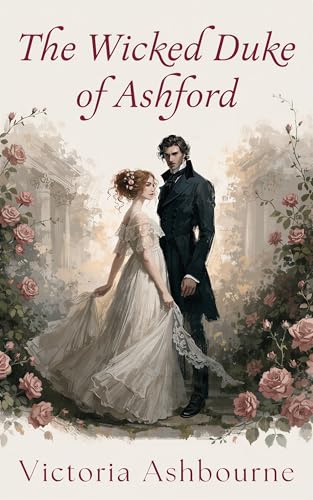
An eight-minute visit. One very serious bluestocking. And a duke all of London has decided is wicked.
Clean, slow-burn Regency romance. Every book stands alone with a happily ever after.
Chapter One
London, 1819
Miss Genevieve Ashworth had, over the course of her twenty-three years on this earth, developed a comprehensive philosophy regarding dukes.
They were, to a man, insufferable.
She had formed this opinion not through any single dramatic incident — she was not a woman who formed strong opinions on the basis of single incidents, preferring instead the more reliable method of accumulation — but through the patient, empirical gathering of evidence across three London Seasons. The evidence was extensive, consistent, and did not admit of significant counterargument. There was the Duke of Pemberton, who had kept her waiting forty minutes for a promised dance and then claimed he had simply forgotten, with the easy indifference of a man who has never in his life been required to account for his own unreliability. There was the Duke of Harcastle, who addressed all unmarried women in the tone one might use with a moderately clever spaniel — warm, encouraging, and faintly condescending, as though female intelligence were a charming novelty that one appreciated without quite taking seriously. There was the Duke of Wexford, who had spent an entire dinner party talking about himself in the third person and had apparently found nothing remarkable about this, while twelve people around the table constructed expressions of polite attention and thought about something else entirely.
Three dukes. Three Seasons. The evidence was conclusive.
And now, apparently, the Duke of Ashford.
He had arrived at Lady Worthington’s annual spring ball approximately forty minutes after the dancing began, which was late enough to be noticed but not so late as to be remarked upon — the precise calibration of a man who understood that his arrivals were social events in themselves and had decided to exercise this power with minimal effort. Genevieve had observed him from across the ballroom with the attention she gave most things: thorough, unhurried, and without particular investment in the conclusion. He had spoken to his hostess — briefly, correctly, with the air of a man discharging an obligation rather than conducting a pleasure — nodded to three or four men he appeared to actually know, refused a glass of champagne from a passing footman with a small motion of his hand that managed to communicate both thanks and absolute disinterest simultaneously, and then positioned himself against the far wall beneath the second-largest chandelier.
And there he remained.
He stood with his hands clasped behind his back and his gaze moving slowly around the room with the expression of a man conducting a survey of a landscape he finds both familiar and unremarkable. The musicians were playing a lively country dance. Couples were moving through the figures with the particular mixture of concentration and performance that dancing in public always required. Conversation moved around the room in waves, rising and falling, punctuated by the occasional laugh and the steady undercurrent of the Season conducting its business. It was, by the standards of London in June, a very good ball — Lady Worthington set an excellent supper, her rooms were well-proportioned and not overcrowded, and she had the rare gift of assembling a guest list that contained enough variety to generate genuine conversation rather than the social monoculture that produced tedium.
None of this appeared to interest the Duke of Ashford in the slightest.
He radiated disapproval at the assembled company with such concentrated intensity that the conversation in his immediate vicinity had dimmed noticeably, like a lamp turned low. Two of the younger debutantes — girls of seventeen or eighteen in their first or second Season, still at the stage where everything felt consequential and a duke’s attention, or lack of it, carried enormous weight — had already migrated to the opposite end of the ballroom, finding the atmosphere in his quarter somewhat oppressive. Genevieve noted their departure and did not blame them. She had felt the weight of his indifference from thirty feet away.
He was, she would grant him, extremely good-looking. She made this assessment with the dispassion of a woman conducting an inventory rather than an admiring one: dark-haired, broad-shouldered, with the kind of angular jaw that portrait painters loved and that Genevieve privately thought looked as though it had been assembled from architectural salvage, all clean lines and structural intention. His evening clothes were immaculate and entirely unornamented — no jewellery, no decorative fobs, nothing that might suggest any interest in being looked at. He had the bearing of a man who had spent years in the army and carried the habit of it still: straight, still, with an economy of movement that communicated both physical capability and complete self-possession. Even standing against a wall doing nothing in particular, he occupied his space with a definiteness that made the people around him seem slightly provisional by comparison. Insufferable, Genevieve thought. Definitively, comprehensively insufferable.
“He is very handsome,” said her cousin, Miss Arabella Hurst, appearing at Genevieve’s elbow with a fresh glass of lemonade and the particular gleam in her eye that had preceded every inconvenient observation she had made since she arrived in London three weeks ago.
Arabella was nineteen and this was her first Season, and she brought to it the quality of attention of someone encountering a new and fascinating country. Everything interested her. Everything connected to everything else in chains of significance that she communicated with the breathless enthusiasm of a natural philosopher who has just noticed that the world is very large and very full. Genevieve was deeply fond of her, and found her simultaneously the most enjoyable and the most exhausting company she had encountered in three Seasons.
“He is very rude,” Genevieve replied pleasantly. “They are not the same thing, Bella, though I grant you they frequently coincide.”
Arabella giggled. She had not yet developed the particular protective layer of irony that three Seasons tended to produce in women of intelligence — the layer that allowed one to observe the marriage market with equanimity rather than either terror or excessive optimism. Genevieve hoped the layer would develop before Arabella made any irrevocable decisions on the basis of a pair of grey eyes and an adequate fortune.
“Mama says he has not come to Town in three years,” Arabella continued, lowering her voice to the confidential register she deployed for information she considered significant. “She says he has been at his estate in Derbyshire, which she considers deeply eccentric behaviour for a man of his standing. Though she also says Ashford Park is utterly magnificent, with a lake and a proper park and a library that is apparently the envy of half the county, so perhaps he simply prefers it there.”
“A reasonable preference,” Genevieve said. “London in the Season is not universally appealing.”
“You say that every year and yet here you are.”
“Here I am,” Genevieve agreed, which was not quite the same as an admission that she found the Season anything other than a necessary exercise. She was here because Arabella was here, and Arabella was here because it was her first Season and required the support of a cousin who knew the terrain, and Genevieve was the only cousin available and had, in a moment of familial affection that she occasionally found herself regretting in the abstract while not actually regretting it in practice, agreed to come. She had packed her trunks with the resigned practicality of a woman who has done this before and knows exactly what to expect, and she had arrived in London with precisely two objectives: to help Arabella navigate the Season successfully, and to avoid, herself, the various matrimonial manoeuvres that three Seasons of availability had apparently failed to conclude.
She had a list. It was a very sensible list, compiled over the winter with the close attention she brought to most problems worth solving. The list detailed the qualities she considered necessary in a potential husband, arranged in order of priority, with brief annotations where she had felt clarification was warranted. It was not a romantic document. It was the product of three years of careful observation of marriages both successful and otherwise, and it represented her considered view of what was actually required rather than what was conventionally desired.
The Duke of Ashford did not appear on the list. This was, she would later reflect, the first indication that the list had some structural limitations she had not fully accounted for.
“Seventeen thousand a year,” Arabella said, with the solemnity of someone reciting a figure of genuine theological significance. Genevieve turned to look at her cousin with gentle reproach.
“Bella.”
“I am merely noting—”
“You are itemising the man’s assets as though preparing an auction catalogue. You and every other woman in this room.”
“Every woman in this room who is paying attention,” Arabella corrected, with a reasonableness that was, Genevieve thought, slightly alarming in someone of nineteen. She was becoming, Genevieve realised, considerably more perceptive than her enthusiastic exterior suggested. “Seventeen thousand a year and Ashford Park and a house in Grosvenor Square and another in — somewhere, Mama said, though she could not quite remember where. And he is not, actually, being rude to anyone specifically. He is simply standing there. The rudeness is more of an ambient quality.”
“That is a generous interpretation.”
“I am a generous person.” Arabella tilted her head, studying the object of their mutual analysis with the frank curiosity of someone who has not yet learned to pretend she is not looking. “He looks rather as though he made an appointment with the wallpaper and is keeping it out of a sense of obligation.”
Genevieve looked at the Duke of Ashford, who was indeed maintaining his position beneath the chandelier with the steadfast commitment of a man who has decided on a course of action and intends to see it through. “He looks,” she said, “like a thundercloud given human form. Very well-dressed. Excellent posture. Fundamentally meteorological.”
“Genevieve.” Arabella’s voice was gently reproving. “That is unkind.”
“It is accurate,” Genevieve said. “Accuracy and kindness are different categories. I aspire to both but do not always achieve simultaneity.”
Arabella was quiet for a moment, and then said, with the directness that was her best quality and that Genevieve should perhaps have been more alert to: “And what are you doing, if not the same calculation? You have been looking at him since he arrived.”
Genevieve paused. It was a fair question, and she applied to it the same honesty she applied to most things. She was standing at the edge of a ballroom cataloguing a man’s qualities and finding them wanting, which was not obviously different from cataloguing his assets and finding them adequate. Both were assessments. The subject matter differed; the activity was the same.
“I,” she said, after a moment’s honest consideration, “am conducting an empirical study of my own philosophical consistency and finding it somewhat imperfect. And then I am going to fetch myself another glass of lemonade and spend the remainder of the evening talking with Mrs. Caldwell about her botanical research, which I expect will be considerably more edifying than anything else on offer.”
“Mrs. Caldwell is in the corner by the potted palm,” Arabella said helpfully. “She has a new illustrated volume that she has been trying to show people all evening. Most people have been avoiding her.”
“Then she will be very glad to see me,” Genevieve said.
She smoothed her evening gloves — white kid, slightly too warm for the room but correct, always correct, the invisible armour of a woman who understood that presentation was the price of admission to a world that judged on surfaces before it looked deeper — and set off across the ballroom with the purposeful stride of someone who has identified her destination and intends to reach it.
She had taken precisely four steps when she walked directly into the Duke of Ashford.
The collision was entirely her fault, which she acknowledged immediately and without evasion, because that was the kind of person she was. She had been looking toward the corner where Mrs. Caldwell sat, and he had been moving from his position beneath the chandelier toward — she would never know where, because the trajectory was interrupted — with the quiet, deliberate purpose of a large man who had spent thirty-two years being accustomed to people moving out of his way and had not, on this particular evening, accounted for a woman moving toward him with equal purpose and considerably less awareness of his existence.
They met in approximately the geometric centre of Lady Worthington’s ballroom, and the consequence was immediate, irreversible, and mortifying.
The lemonade, which Genevieve had been holding in her right hand with the casual security of someone who has been holding glasses at parties for three Seasons and has never previously had cause to reconsider this approach, described a brief and elegant arc through the candlelit air. It caught the light as it went — she would remember this detail later with the particular clarity of moments that are simultaneously horrible and oddly beautiful — and then deposited itself with cold, thorough, completely final precision down the front of the Duke of Ashford’s waistcoat.
The waistcoat was cream-coloured silk. The lemonade was cold. The silk absorbed it with immediate and visible enthusiasm.
There was a moment — brief, crystalline, eternal in the specific way that genuinely horrible moments tend to stretch themselves out of all proportion to their actual duration — in which everything stopped. The music continued. Conversation continued at a radius of approximately six feet in every direction. The rest of Lady Worthington’s ball proceeded with its customary good cheer. But in the small, candlelit pocket of reality that contained Genevieve Ashworth, the Duke of Ashford, and a rapidly expanding lemonade stain on a very expensive piece of tailoring, everything was perfectly, horribly still.
She looked up.
She had noted, from across the room, that he was tall. This had registered as an observable fact, like the colour of his coat or the quality of his posture. Up close, tall acquired a different character. He was considerably taller than she had appreciated at thirty feet, which was perhaps the perspective at which tall ceased to be a descriptive term and became something more like a governing condition of the immediate environment. The jaw was, if anything, more architectural at close range — she could see the precise line of it, the controlled set, the specific quality of a face that expressed very little by deliberate choice rather than by absence of feeling.
His eyes dropped to meet hers. They were grey — she had noted this from across the room — but the precise shade of them was different up close: not the flat grey of overcast sky but something cooler and more specific, pale to the point of silver, with the quality of reflecting light from sources not immediately apparent. They dropped to her face with the controlled precision of a man who has been startled — genuinely startled, she thought, not merely inconvenienced — and is applying the full force of his self-possession to managing not to show it.
He looked at the waistcoat.
He looked at her.
His expression moved through several stages in the space of perhaps two seconds: the initial impact of surprise, carefully managed; something that might, in a less controlled man, have been exasperation; and then something else entirely, something she could not immediately name, that arrived and settled and was neither of the previous things.
He said: “Miss—?”
And Genevieve Ashworth, who had been managing difficult situations with composure since the age of twelve, when she had learned that the most useful thing available to her in almost any circumstance was the appearance of calm even when calm was not precisely what she felt, straightened her spine to its full height — which was not inconsiderable, though it remained substantially below his — and said:
“Ashworth. Miss Genevieve Ashworth. And you are the Duke of Ashford, and I am dreadfully sorry about your waistcoat, and if you would simply hand me a napkin from that table there, we can address the situation before the lemon sets into the silk. Lemon sets quickly in warm rooms. We have perhaps two minutes.”
There was a pause. It was shorter than the previous pause — perhaps three seconds rather than the eternal variety — and in it she watched something move across his face that she could not immediately categorise, which was unusual. She was generally quite good at categorising expressions. She had made rather a study of it, as a woman who had spent three Seasons watching people perform feelings they did not have and conceal feelings they did.
This expression was something she had not encountered before. It was not the reflexive social management of a man constructing an appropriate response. It was something more like — genuine encounter. The expression of a person who has met something unexpected and has not yet decided what to do with it.
“You are very composed,” he said, “for a woman who has just destroyed a garment that cost more than most people earn in a month.”
“I am very composed,” she agreed, accepting the napkin that he had retrieved from the side table — efficiently, she noted, without fuss, without making a production of the gesture — and applying it to the damp expanse of his lapel with the practical attention of someone addressing a problem rather than performing distress about one. “Because I have found that composure is almost invariably more useful than its alternatives. Distress would not unspill the lemonade. It would simply add a second difficulty to the first. There.” She stepped back and assessed her work. The napkin had done what napkins could do, which was limited but not negligible. “The worst of it is addressed. You will want cold water before it dries — warm water will set the stain — and a laundress who knows her business. The silk should be quite salvageable if it is dealt with promptly.”
She returned the napkin. He took it. They stood in the middle of the ballroom looking at each other, and Genevieve was aware, with a clarity that she found both sharp and somewhat inconvenient, that she had been looking at this man from across a room for twenty minutes and had formed a complete and confident assessment of him, and that the assessment was not surviving close inspection in the way she had expected it to.
He was not, up close, the social performance she had categorised from a distance. He was something more specific than that.
“You were discussing me,” he said. Not an accusation. The flat, neutral observation of a man reporting a fact he has noted and is choosing to acknowledge directly rather than pretend he has not noticed. “You and the young woman by the pillar.”
Genevieve felt the colour rise in her cheeks — an involuntary response she had been attempting to train away for years with limited success. “We were observing the room,” she said, with the careful precision of someone selecting the most accurate available statement. “As one does at these events.”
“You called me a thundercloud given human form.” There was the faintest emphasis on thundercloud — not ironic, exactly; more the quality of a man testing the weight of a word, turning it over to see what it was made of.
“I—” She considered, for approximately half a second, whether there was a graceful way to manage this. She concluded there was not. The only available direction was forward. “I apologise for the comparison if it caused offence. Though I would note that the meteorological accuracy of the description is arguably in its favour. Thunderclouds are, in their way, impressive phenomena.”
He stared at her.
She held his gaze with the steadiness she had been cultivating since the age of twelve, when she had learned that the first person to look away invariably lost whatever conversation they were in, and that losing conversations was a habit she could not afford.
The ballroom moved around them. The music continued. Somewhere nearby, someone laughed at something. The Season conducted its elaborate, glittering, purposeful business in every direction.
And then — she saw it happen. Saw the precise moment it arrived, the exact instant when something shifted in the controlled landscape of his face. The corner of his mouth moved. It was not a smile. It was the structural suggestion of one, the ghost of one, as though the relevant muscles had received an instruction they were slightly surprised to be executing and were proceeding with cautious experiment.
“Sebastian Ashford,” he said. “The thundercloud himself.”
Something loosened in her chest. Not much. A very small thing. But she noticed it, with the precision she applied to all internal events of potential significance, and filed it under: information requiring further analysis.
“Genevieve Ashworth,” she replied. “The woman who has just simultaneously ruined your evening and your waistcoat.”
“Only the waistcoat,” he said. “The evening had not previously been going well enough to be ruined.” A pause, in which he appeared to be considering something, in the way of a man who actually thinks about what he is going to say before he says it. “It has, in the last several minutes, taken an unexpected turn for the better.”
She told herself, firmly and with conviction, that the warmth that moved through her chest at this was nothing more than the natural human response to having successfully navigated a socially disastrous situation. Relief, specifically. The particular warmth of relief.
She almost believed it.
They were still standing in the middle of Lady Worthington’s ballroom. She became aware of this. She also became aware that they had been standing here for longer than was entirely unremarkable, and that several people in the immediate vicinity were observing them with the bright-eyed attention of individuals who have identified something potentially interesting and are not going to look away until it resolves itself.
“I should—” she began, intending to excuse herself, find Mrs. Caldwell, and spend the rest of the evening with botanical illustrations and sensible conversation, which had been her plan before fate had intervened in the form of inadequate spatial awareness.
“Would you do me the honour of the next dance?” he said, simultaneously.
She stopped.
He appeared, very slightly, to register that he had said this before he had fully decided to say it. There was a fractional pause — not regret, she thought, not precisely; more the quality of a man who has observed himself doing something unexpected and is assessing the observation.
She looked at him steadily. “Your Grace, you are aware that you have spent the last forty minutes communicating quite clearly to the room at large that you would rather be somewhere else entirely.”
“Yes.”
“And now you are asking me to dance.”
“Yes.”
“May I ask why?”
He was quiet for a moment. The question required an honest answer and he was, she was beginning to understand, a man who gave honest answers when he had decided to give answers at all. He was also a man who actually thought about the question before answering, which she found both unusual and, against her better judgment, rather appealing.
“You are the only person I have spoken to this evening,” he said at last, “who has said something that required me to think. I find that I am reluctant to let the conversation end.”
It was possibly the most honest thing anyone had said to her in a ballroom in three Seasons. It was also, she reflected, dangerously effective, because she had spent three Seasons looking for exactly that quality in the conversations available to her and finding it very rarely, and here it was, delivered without decoration by a man she had spent twenty minutes dismissing as insufferable.
The list, she thought. The list had some significant structural limitations.
“One dance,” she said. “And then we are even for the waistcoat.”
The ghost-smile returned, slightly more substantial this time, as though it was gaining confidence. “I was not aware a debt had been established.”
“All social interactions involve a certain currency,” she said pleasantly. “The lemonade created an obligation. One dance discharges it. After that we are at equilibrium.”
“And then?”
She took his offered arm — gloved hand on dark wool, the conventional gesture, entirely unremarkable, except that it was not unremarkable to her, which she noted and set aside for later consideration. “And then,” she said, “we shall see.”
He led her to the floor.
He danced, she discovered, with the same quality he appeared to bring to everything: complete, unhurried competence and no excess of effort. His hand at her waist was correct — the proper social distance, nothing that could be called presumptuous — and yet there was a quality to it that was different from the conventional pressure of a man performing the mechanics of a dance. It was deliberate. Present. The hand of a man who was conscious of what he was doing.
The country dance required the partners to separate and reunite in the figures, which meant their conversation was conducted in fragments — each exchange brief, interrupted by the pattern before it could develop, resumed when the figure brought them back together. She found, to her continuing inconvenience, that she was using the intervals of separation not to recover her composure but to think about what she wanted to say next.
“You are good at this,” she said, the first time the figure brought them close.
“I had an excellent dancing master.” His voice had a different quality in conversation than it had in the brief, clipped social exchanges she had observed from across the room. Not warmer, exactly — warmth was not quite the right word — but more present. More engaged. “My mother was determined that at least one of her sons would not disgrace the family at a court presentation. I was, apparently, the most promising material.”
“How many brothers do you have?”
“Three.” He moved through the figure with the fluency she had already noted, guiding her with a light, sure hand. “Edmund, who is the charming one. William, who is in the army and contrives to be more reckless than Edmund, which is a considerable achievement. And Miles, who is eighteen and currently the source of various difficulties.” A pause. “And sisters. Three.”
She noticed the pause. She noticed, too, the slight difference in the quality of his voice when he said sisters — not dramatically different, not something that most people in a noisy ballroom would detect, but she was not most people, and she detected it. “You are close to them,” she said.
“I am responsible for them.” It was the answer of a man who had given this answer before. An automatic answer, the response of habit. She considered it as the figure moved them apart and then back together. “Those are not the same thing,” she said, when she could.
He looked at her. Not the managed look, the controlled social gaze — the real thing, the gaze of a man who has been given something to think about and is thinking about it. “No,” he said, after a moment. “I suppose they are not.”
The pattern separated them again. When it brought them back: “You said their names differently than your brothers’. There was more warmth when you said them.”
“You are very observant.”
“I am a woman without great fortune or title at her third London Season,” she said. “Observation is one of the more reliable tools available to me.”
Something moved in his face — briefly, before the composure settled back over it. “What have you observed,” he said, “in three Seasons?”
She thought about this honestly, which was the only way she knew how to think about things. “That most people in rooms like this one are performing a role they did not choose and cannot easily leave. That the performance is so habitual they have largely forgotten there is a person underneath it. That the most genuine conversations happen in the margins — at discussions of botany with women like Mrs. Caldwell, or in gardens when everyone else has gone inside, or at supper tables where someone has made a seating error and placed two people together who would not normally speak.” She paused. “And that some people use their worst qualities as armour. Because it is safer to be found wanting on terms you have chosen than to be found wanting on terms you have not.”
The music moved them apart.
She was aware, in the interval, that she had said more than she had intended. She had said the thing she actually thought, which was not always the same as the thing that was appropriate to say at a ball, in a country dance, to a man she had met twenty minutes ago under circumstances involving lemonade.
When the pattern brought them back together, his expression had changed. Something had opened in it, briefly — something that was behind the controlled management, something more fundamental — before the shutter came back down.
“You are speaking about me,” he said.
“I was making a general observation,” she said, which was true as far as it went.
“Miss Ashworth.”
“Your Grace.”
“You are the most exhausting person I have met in three years.”
She considered this. “I take that as a considerable compliment. The alternative — being the least exhausting person you have met — would suggest a quality of conversation I find entirely unappealing.”
He laughed.
It came out rough and slightly unpracticed, as though it had not been used for a while and needed a moment to remember how it worked. It was not the social laugh, the performed version — it was the real thing, arriving before he could manage it, and it was full and genuine and surprised, and several people in the immediate vicinity turned to look, because the Duke of Ashford laughing at a ball was apparently the kind of event that warranted attention.
Genevieve felt the warmth in her chest, which she had been telling herself was relief, intensify into something that she could not quite sustain the relief explanation for.
The second dance was a waltz.
She had not expected the waltz. She had expected the engagement to conclude — one dance, as agreed, and then equilibrium and Mrs. Caldwell and the sensible remainder of the evening. Instead, the musicians moved into the opening bars of the waltz, and he offered his hand again with the look of a man who has made a decision and is not explaining it, and she took his hand, because she had also made a decision and was not examining it too closely.
The waltz gave no intervals. The waltz was sustained proximity from first bar to last — his hand at her waist, her hand in his, the two of them turning together through the figures in the held closeness that the dance required and that the ton still found faintly, pleasantly scandalous. She had danced waltzes before. She had found them agreeable and unremarkable.
This was not unremarkable.
“My dancing master,” he said, when they had been turning for perhaps a minute in the particular quality of silence that is not actually silence but the absence of necessary speech, “was a man named Girard. He had studied in Vienna and he had a theory about the waltz.”
“What theory?”
“That it was a moral exercise as much as a physical one. He said that a man who could not be trusted in a waltz — who used the proximity for purposes the lady had not agreed to, or who was careless with the lead, or who failed to attend to his partner’s comfort — was a man who could not be trusted in anything that mattered.” He looked at her steadily over the movement of the dance. “I was fourteen. I found the formulation clarifying.”
“You have carried a dancing master’s moral philosophy around for eighteen years.”
“I carry a great many things for a long time,” he said. “It is a quality. It is occasionally also a limitation.”
She looked up at him. The light from the chandeliers was catching the silver of his eyes, and they were very close, and she was having a thought she recognised as the beginning of a significantly more serious problem than she had walked into this ballroom with. “What are you carrying,” she said carefully, “that is a limitation?”
The question was too direct. She knew it as soon as it arrived. Three Seasons had not been sufficient to fully cure her of the tendency to say the thing she actually wanted to know, when she wanted to know it.
He was quiet for a moment. The waltz turned them, and the ballroom moved around them, and the Season conducted its business at a perfectly maintained distance.
“Conclusions,” he said at last, “that I reached a long time ago and have not revisited. About what is possible. About what is worth wanting.” He paused. “I find that this evening has provided some evidence that the conclusions may have been somewhat — premature.”
She held his gaze.
“That,” she said, “is the most interesting thing anyone has said to me in a ballroom.”
“I told you the conversation was worth continuing,” he said, and the ghost-smile arrived again — fuller this time, more certain of itself, as though it had found its footing and intended to stay.
The waltz ended.
He returned her to her position near the potted palm — correctly, properly, with the social formality that the occasion required. He said the right things. He bowed. He was, in all of this, exactly as correct as he had been all evening.
But as he turned to go, he paused — briefly, just the length of one drawn breath — and looked back at her over his shoulder. It was not a dramatic look. It was not a look that announced itself as significant. It was simply a look that noted where she was and filed the information, and then he turned and walked away through the crowd, and within thirty seconds he was simply one dark coat among many.
Arabella materialised at Genevieve’s elbow with the timing of someone who has been watching from a precisely calibrated distance and has judged the moment correctly. “Well,” she said.
“He was taught to dance by a man named Girard,” Genevieve said, “who held that the waltz is a moral exercise.”
Arabella stared at her.
“Genevieve,” Arabella said slowly. “That is not what I was asking.”
“I know what you were asking.”
“And?”
Genevieve looked at the place in the crowd where she had last seen him and could no longer find him. She thought about the ghost-smile and its three appearances, each one slightly more substantial than the last, gaining confidence as the evening went on. She thought about a man who had spent three years in Derbyshire and had arrived at a London ball looking like bad weather and had laughed, unexpectedly, genuinely, in the middle of a country dance because she had said something he found funny.
She thought about the warmth in her chest, which she had been telling herself was relief, and which was becoming increasingly difficult to sustain as an explanation.
“He is not,” she said carefully, “what I thought he was.”
Arabella looked at her with the perceptive brown eyes that were, behind their enthusiastic exterior, rather sharper than most people gave them credit for. “Is that good or bad?”
Genevieve smoothed her gloves. She looked toward the corner where Mrs. Caldwell was still sitting with her illustrated botanical volume, patient and unperturbed, waiting for someone to come and discuss the asymmetrical lobes of alpine wildflowers with her.
“I don’t know yet,” she said honestly.
She went to find Mrs. Caldwell.
She did not, for the remainder of the evening, think about the Duke of Ashford.
She thought about him constantly.
Want to know what happens next?
Keep reading on Amazon. The Wicked Duke of Ashford is free to read in Kindle+.
Keep reading on AmazonOr start with a free Christmas novella, sent to your inbox.
Get the free novellaExcerpt from The Wicked Duke of Ashford by Victoria Ashbourne. © 2026 Victoria Ashbourne. All rights reserved.