Free sample · The Carramore Chronicles, Book 1
The West Wind at Carramore
Read the whole of Chapter One free, right here.
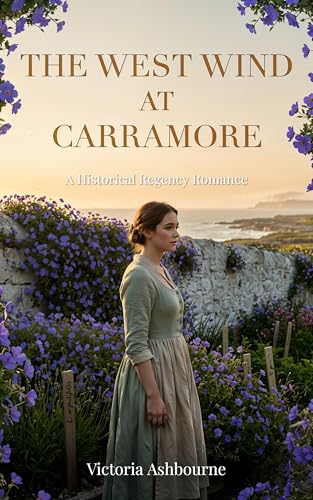
A land surveyor writes one true sentence about a flower. The woman who grew it reads every word.
Clean, slow-burn Regency romance. Every book stands alone with a happily ever after.
Chapter One
The road from Galway town to the Carramore estate ran west along the coast for eleven miles, and for the last four of those miles it ran badly. Conal Doyle had been warned about this in a letter from the Ashby family solicitor — the road deteriorates after Kinvara; your driver will know it — and had supposed the warning a polite understatement of the kind that appeared in all correspondence concerning the west of Ireland. He had been right. The road deteriorated after Kinvara in the manner of a sentence that forgets what it meant to say: narrowing, then roughening, then abandoning any pretence of surface altogether and becoming instead a series of suggestions between limestone outcrops, each suggestion damp and the next one worse.
He did not complain about this. He was not much given to complaint. He had a flask of coffee that had been hot when he left Galway and was now merely warm, and a leather satchel of survey notes that he had spent the previous evening reading in his inn room, and a surveying case that occupied the seat beside him and had survived worse roads than this. He watched the landscape instead, which was, he had to admit, doing something he had not anticipated.
He had surveyed land from Antrim to Cork. He knew the west of Ireland in the way a man knows a language he has studied without ever speaking — the grammar correct, the music absent. He could name the rock formations, describe the glacial processes that had shaped the Burren's limestone pavement, account for the drainage patterns and the soil composition and the particular challenges of building on karst. He had expected the coast west of Galway to be grey and spare and difficult, because it was grey and spare and difficult, and he had prepared for it accordingly.
What he had not expected was the quality of the light.
It came off the Atlantic at an angle that seemed to belong to a different hour than the one the clock suggested — not the flat light of mid-morning, which it was, but something more oblique, more considered, as though it had spent a long time crossing water and had arrived with something to say about the journey. It turned the limestone pavement along the road's edge from grey to something closer to silver, or cream, or the particular colour of old paper held up to a window. It made the walls of the fields look ancient and the puddles in the road look like apertures into something else entirely.
Conal looked at it for longer than was necessary and then noted it in his mind under things that were not useful and set it aside. He was here to do a job.
The job was particular. A boundary dispute had arisen between the Carramore estate, held by Mr James Ashby, and the adjacent holding to the north, the property of a Mr Fenton, whose family had held the land for three generations and who had recently engaged a solicitor of his own. The dispute concerned a strip along the northern boundary — approximately forty yards wide at its narrowest point, wider where the land curved east toward the road — and the question was whether certain historical documents placed it within the Carramore title or within Fenton's. Conal's task was to survey the boundary as it currently existed on the ground, document every structure, enclosure, and cultivated portion within the disputed strip, and produce a written record accurate enough to be submitted to a court if the matter went that far.
He hoped it would not. It usually did not, once a proper survey was in hand. Men who had been arguing about a strip of land for two years tended to settle once they could see it clearly on paper — once the disputed territory became a set of measurements rather than a grievance. There was something clarifying about a boundary marked and recorded that rarely failed to reduce the temperature of a dispute. Conal had produced forty-three survey reports in fifteen years. Thirty-one of them had settled before reaching court.
He would be at Carramore for four weeks, possibly five.
The carriage turned through a gate of rough-cut limestone pillars — each one the height of a man, set without mortar, held by their own weight and the weight of time — and came down a long drive between walls of the same pale stone. The walls were old, the coping stones weathered to a softness that new stone never had. Moss in the joints. A fern in a crack near the gate that had been there long enough to split the stone around it. Conal noticed these things without deciding to notice them; observation was the habit of his profession and he had long since stopped trying to turn it off.
On the south-facing wall to his left, something grew in a dense curtain. He could not make it out from the moving carriage — only that it was low to the ground and intensely blue-purple, the colour startling against the pale limestone, vivid in a way that the landscape around it was not. He looked at it for longer than he meant to, trying to name it, and could not, and then the wall ended and the house came into view.
He had been looking at limestone for four miles. It was everywhere on the west coast — in the field boundaries, in the outcrops the road was built around, in the pavement that appeared on the hillsides above the village and extended, on the higher ground, as far as he could see. Pale grey, the same colour as the overcast sky. The west was a limestone landscape, which he had known professionally and was now understanding in the way you understood things from inside them rather than from a map.
The blue-purple against that grey was therefore startling in a way it would not have been in a different landscape. The colour was the colour of an argument being made — definite, committed, not asking permission from the stone it grew from or the sky above it. He looked at it until the wall ended, aware that he was looking for longer than the moving carriage required him to look, and then the gate came and then the house.
It was a long, low building of two storeys, the same limestone as the walls, west-facing across a sweep of rough grass that ran down to the sea cliff. Not grand. Not even particularly imposing. It had the look of a house that had been built to last in a difficult place and had done exactly that, without apparent effort, for a very long time — considered, plain, well-made, without a great deal of interest in impressing anyone who might happen to arrive at its front door.
Conal approved of this, without quite meaning to.
The door opened before the carriage had fully stopped, and a man came out to meet him. Perhaps forty, tall, dark-haired, with the unhurried manner of someone who had decided long ago that hurry was not generally worth the effort and had not found cause to revise this conclusion. He came around to the carriage door and put out his hand before Conal had properly descended, which was the manner of a man who does not stand on ceremony and expects others not to either.
"Mr Doyle. James Ashby. Welcome to Carramore." His handshake was firm and without performance. "The drive from Galway is unkind at the best of times. Come inside."
"Thank you for receiving me, Mr Ashby."
"You're doing us a service." This was said simply, without irony or effort. "My wife is in the garden. She'll want to meet you before dinner — she's been expecting you since Tuesday."
"I was delayed in Dublin. A commission that ran over."
"She wasn't concerned. She simply likes to know when things are happening." He held the door and glanced at the surveying case as the driver carried it up. "Your equipment can go in the library. West-facing room, best light in the house. You'll have it to yourself in the mornings."
"That suits me very well."
"Good." James Ashby said this in the manner of a man who uses the word to cover a range of conclusions and sees no reason to elaborate. "Come in, then."
The hall was stone-floored and simply furnished — a long table of dark wood, a pair of chairs against the wall, a coat stand holding a collection of outdoor wear that spoke of daily use in difficult weather. On the wall above the table, in a plain frame, hung a botanical print. Conal paused in front of it. The subject was a wood sorrel — Oxalis acetosella, he knew it at once — and the linework was precise in a way that went beyond mere accuracy, that had understood something about the plant's particular quality of delicacy, the way the leaves folded in shade. There was a hand-written annotation in the margin, in a small and careful script, but he was too far from it to read the words.
He did not pause long. He was here to work.
* * *
The library was west-facing, as James Ashby had promised, and the light in it at four in the afternoon was the same quality as the light on the road — angled and slightly other, as though it had come a long way and was not in a hurry to leave. The room was not large. Two long tables of oak, scarred with use. Shelves of well-used volumes, many of them on natural history and land management, a few on history, several in Irish that Conal could not read. A globe on a stand near the window, which had been repaired at the equator with a strip of paper that had been there long enough to yellow. Along the window shelf, a row of botanical specimens in glass — stems and leaves suspended in solution, each labelled in a careful hand, the labels faded but legible.
He uncapped his ink and opened his field notebook to the first clean page and wrote the date, the name of the estate, his name, the name of the commissioning solicitor. This was how he began every survey: the plain facts first, a foundation to build on. He had done it forty-three times and the ritual had not grown stale. It remained, each time, the moment when the job became real — when the documents became a physical survey, when the abstract boundary became a thing that needed to be measured and recorded.
He looked at the estate map above the fireplace for a long time. The draughtsman had been someone who understood what they were drawing: the proportions were trustworthy, the features placed with a care that went beyond the competent. Someone who had walked the land before drawing it. Someone who had understood that a map was not a description of a place but a kind of argument about it — what mattered, what related to what, what could be understood without going there.
The 1789 map argued, among other things, that the north field and the channel and the garden were a single system. The channel managed the water from the upper pavement and made the north field workable, and the north field in its turn provided the ground in which the garden had been established. Remove the channel and the field was marsh; remove the field and the garden had no context; remove the garden and you had a field and a channel that served a farm rather than an estate that had been building something over time.
He noted this. He noted it as a surveyor notes things that are relevant to the legal question, which this was — the channel's relationship to the estate was the heart of Fenton's claim, and understanding the system was necessary to assessing the claim. He also noted it in the other way, the way that had no professional application and that he would not put in the field notes, because it was not that kind of observation.
He was still looking at the map when he heard footsteps in the hall.
He set his surveying case on the table nearest the door and his roll of draft paper beside it. He uncapped his ink and opened his field notebook to the first clean page and wrote the date, and the name of the estate, and his name, and the name of the commissioning solicitor, as he always began a new survey — the plain facts first, a foundation to build on. Then he looked at what he had written for a moment and looked at the room.
There was a framed map above the fireplace. He crossed to it. The 1789 estate map, hand-drawn on vellum — he had seen a copy of this in the solicitor's file, but the original was larger and better detailed. The draughtsman had been competent: the proportions were reasonable, the main features clearly placed. But it predated the ordnance conventions that had come in over the following decades, and its boundary markings relied on natural features rather than fixed points — a stream, a limestone outcrop described as the long flat stone, a stand of ash trees that may or may not still exist. He would need all of this confirmed on the ground before it meant anything.
He was still at the map when he heard footsteps in the hall and voices, and then the door opened.
James Ashby entered first. Behind him came a woman of perhaps thirty-five — dark-haired, composed, with an expression of genuine interest that she made no effort to moderate. This was Mrs Frances Ashby; Conal knew it before introductions were made, because she looked at him as though she were actually curious about what she would find, which was disconcerting in a way he could not immediately account for. Most people looked at surveyors with polite wariness.
And behind her, coming through the door last and making no particular entrance of it, was another woman.
She was perhaps thirty, fair, her hair pinned with the practicality of someone who does not think much about her hair. A grey dress with a working apron over it, plain and well-made. Her hands, he noticed immediately, were marked with soil at the fingers — she had been in a garden recently and had cleaned her hands but not thoroughly enough, the soil still in the creases, the particular darkness of good garden earth that does not come out entirely with washing.
She had the particular quality of stillness that is not passivity but its opposite: the stillness of a person who has already decided what she thinks before entering a room and sees no reason to advertise the fact. It was a contained kind of stillness, the kind that is arrived at by practice rather than temperament — Conal had met people who were naturally still, and they were different from this, which was the stillness of someone managing something. He had been in rooms with people managing things for fifteen years and he recognised the quality, though he could not have said precisely what it was she was managing.
She was looking at his surveying case on the table with an expression that was entirely neutral and, Conal thought with the certainty of a man who has learned to read what people are not saying, not how she actually felt about it. Not neutral. Controlled. The difference between these two things was small and significant.
He noted this without deciding what to do with it, which was his habitual approach to observations that had no immediate professional application.
"Mr Doyle," said Mrs Ashby, coming forward with her hand out, "I am very glad you've arrived. The boundary question has been hanging over us since October and I shall be relieved to have it settled — or at least to have moved it from the realm of legal argument into the realm of fact." She said this with the directness of a woman who has thought about the distinction and finds it important. "This is my friend, Miss Sylvia Crane. She is staying with us for the summer. She has been — invaluable, to the garden." The pause before invaluable was barely perceptible, but it was there.
Miss Crane met his eyes. "Mr Doyle."
"Miss Crane."
A moment in which she appeared to assess him, though what criteria she was applying he could not have said.
"Will your survey take you to the north garden?" She asked it without preamble, and without, as far as he could tell, any expectation that the answer would be the one she wanted. She was asking for information, not reassurance.
"It will need to cover all cultivated land within the disputed strip," he said. "I can't say exactly which portions fall within it until I have the boundary staked. That work begins tomorrow."
"Of course," she said. She looked at the surveying case once more, briefly, and then looked away — at the map above the fireplace, at the window, at the middle distance that people look at when they are deciding not to say something further.
James Ashby offered tea. Conal accepted it. The four of them sat for twenty minutes, and the conversation was easy in the manner of people who are all, for their various reasons, glad that the preliminary stage of an uncomfortable matter is underway. Mrs Ashby asked about his journey. He told her about the road. She commiserated with the warmth of a woman who has made the journey many times and has arrived at the conclusion that the road's awfulness is simply one of Carramore's conditions, to be accepted like the weather.
Miss Crane said very little. She drank her tea and listened and looked at the map above the fireplace twice more, with a quality of attention that was not casual. When she did speak it was to ask whether he had surveyed boundary disputes in the west before. He told her: once, in Mayo, the previous year. She nodded and did not ask what that had involved.
At half past four she excused herself, politely, and left the room. He heard her footsteps cross the stone floor of the hall and go toward the back of the house. Toward the garden, he thought.
He turned back to the window and its particular light, which was doing the same thing it had been doing on the road — belonging to a different hour than the one it occupied, making the afternoon feel both precise and extended. He stood there for a moment with his hands in his pockets and thought about the north garden he had not yet seen, and the woman who had asked about it without asking for anything.
Four weeks. Possibly five.
Want to know what happens next?
Keep reading on Amazon. The West Wind at Carramore is free to read in Kindle+.
Keep reading on AmazonOr start with a free Christmas novella, sent to your inbox.
Get the free novellaExcerpt from The West Wind at Carramore by Victoria Ashbourne. © 2026 Victoria Ashbourne. All rights reserved.