Free sample · The Pemberton Chronicles, Book 1
The Unlikely Heiress
Read the whole of Chapters One and Two free, right here.
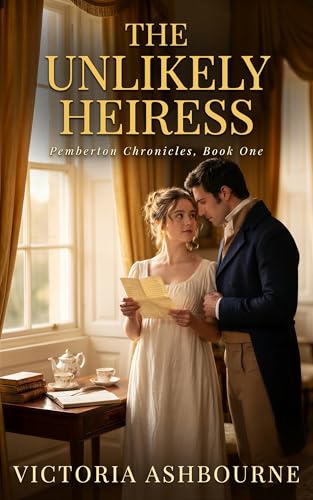
A letter meant for No. 14 arrives at No. 12. Every Tuesday after that, so does the earl.
Clean, slow-burn Regency romance. Every book stands alone with a happily ever after.
Chapter One
The letter arrived on a Thursday, which was already a poor start.
Dorothea Pembridge had learned, through years of managing her father's correspondence, that Thursdays produced nothing useful. Mondays brought bills. Tuesdays brought invitations, accepted or declined with equal indifference. Wednesdays, occasionally, brought something worth reading. But Thursdays produced letters from solicitors, letters from cousins who wanted something, and once, memorably, a letter from a woman in Bath who had confused their address with that of a boarding house and wished to enquire about availability.
This letter was none of those things.
She knew it at once from the seal — dark wax, pressed with a device she did not recognise, a small harp beneath what might have been a coronet. The hand was decisive. The address was wrong.
Lord C. Ashby, 14 Pemberton Street.
They were number twelve.
Dorothea turned the letter over. Turned it back. Set it on the hall table where Mrs Beale had left it, propped against the vase that had not held flowers since October, and looked at it for a moment with the particular expression she reserved for problems that were not, strictly speaking, hers.
Then she picked it up and carried it to her father's study.
Her father was not in his study. Her father was rarely in his study before noon, and it was currently half past nine, and the study itself had the cold, unoccupied feeling of a room that had given up expecting him. Dorothea set the letter on his desk, beside the paperweight and the untouched correspondence from Tuesday, and returned to the hall.
She did not think about it again until after breakfast.
Then she thought about it rather more than was strictly warranted.
The seal was Irish, she was fairly certain. The harp suggested it. Lord C. Ashby — she did not know the name, which meant he was not a regular visitor to the street, which meant the misdirection was either a postal error or the fault of whoever had written the direction in the first place. The hand had been decisive but the address had been wrong, which told her something about the writer, though she could not have said precisely what.
She was not, she told herself, curious. She was methodical. There was a difference.
By eleven o'clock she had written a brief note to the post office explaining the error, sealed it, and given it to the girl to post. By half past eleven she had retrieved it, on the grounds that the post office would simply redirect the letter to number fourteen without explanation, and number fourteen was the Holloways, who were elderly and deaf and would not know what to do with an Irish earl's correspondence.
By noon she had written a second note, this one addressed to Lord C. Ashby, care of Lincoln's Inn, which was where Irish barristers tended to be if they were in London and the letter had the look of legal business about it, and she could not have explained how she knew that except that she had managed her father's affairs long enough to recognise the weight of paper that carried obligation.
She sealed that note also. Then she sat for a moment at the writing table in the morning room, with the misdirected letter in front of her and the autumn light coming through the window at the angle it took in November, flat and honest, and thought about the seal.
A harp beneath a coronet. Lord C. Ashby. The hand that had written that address had known exactly where it was going, she was almost certain.
She posted the note before she could think about it any further.
Chapter Two
He came on Saturday.
Dorothea was in the morning room when Mrs Beale appeared in the doorway with the expression she wore for callers who did not fit any of her established categories — not tradesman, not gentleman of her father's acquaintance, not the sort of young man who left cards and hoped for the best.
"A Lord Ashby, miss," she said, in a tone that conveyed both the title and her reservations about it. "He says he has a letter."
"He has come for a letter," Dorothea said, setting down her book. "There is a distinction."
Mrs Beale's expression suggested she did not find the distinction material.
Dorothea had thought, in the two days since she had posted her note to Lincoln's Inn, that she had formed a reasonable picture of Lord Ashby. A man of business. Precise. The kind of man who sent a clerk for things. She had not thought he would come himself, and she had certainly not thought he would come on a Saturday, which was not a calling day, and she had not — she was precise about this, in the moment between Mrs Beale's announcement and her own rising from the chair — she had not thought about what he might look like.
He was standing in the hall when she came out, hat in hand, and he was taller than the hall quite accommodated, which gave him a slightly compressed look that she suspected he was accustomed to. Dark coat, well-cut. The kind of stillness that was not patience so much as economy — a man who did not move when there was no reason to move.
He had been looking at the vase. When she appeared he looked at her instead, and his expression did not change, which she noted.
"Miss Pembridge," he said. His voice had the particular music of someone who had learned to flatten an accent without quite succeeding, and had at some point stopped trying.
"Lord Ashby." She had the letter in her hand — she had brought it with her, which she had not planned to do, and which she now felt was slightly too eager, as though she had been waiting. She had not been waiting. "I sent a note to Lincoln's Inn."
"You did," he said. "I received it yesterday." He did not explain why he had come in person rather than sending someone, and she did not ask. "I apologise for the misdirection. My clerk wrote the direction."
"The hand was yours," she said, and then wished she had not, because it meant she had looked at the letter closely enough to compare hands, which she had, but which was not information she had intended to share.
He looked at her with an attention that was not quite surprise. "It was," he said. "I corrected it after he wrote it and apparently made it worse."
"You changed a two to a one."
"I did."
"That is a very small error for a barrister."
Something shifted at the corner of his mouth. Not quite a smile — more the decision not to suppress one. "It is," he said. "I shall endeavour not to repeat it."
She held out the letter. He took it, and for a moment they were both holding it, which was not her intention, and she released it before the moment became anything other than a handover of misdirected post.
"Thank you," he said, "for the note to Lincoln's Inn. You did not need to go to the trouble."
"It was no trouble." It had been some trouble. "I was not certain the post office would manage it correctly."
"They would not have," he said, with the certainty of someone who had tested the post office before and found it wanting. He turned his hat once in his hands — the only unnecessary movement she had observed — and then said, "I have kept you from your morning."
"You have not," she said, which was true. Her morning had contained a book she was not fully engaged by and a fire that needed making up. "I hope your business in the street went well."
He paused. A small pause, not quite long enough to be significant. "Well enough," he said. "Good morning, Miss Pembridge."
"Good morning, Lord Ashby."
Mrs Beale showed him out. Dorothea returned to the morning room, sat down, and picked up her book. She read the same paragraph three times before she accepted that she was not, at present, reading.
Outside, the street was quiet. The November light had shifted while he was in the hall, and the morning room was dimmer than it had been, and the fire needed making up, and none of that explained why she was sitting with an unread book in her lap thinking about the particular quality of a pause.
She made up the fire herself and did not think about it again.
Not until Tuesday.
Want to know what happens next?
Keep reading on Amazon. The Unlikely Heiress is free to read in Kindle+.
Keep reading on AmazonOr start with a free Christmas novella, sent to your inbox.
Get the free novellaExcerpt from The Unlikely Heiress by Victoria Ashbourne. © 2026 Victoria Ashbourne. All rights reserved.