Free sample · The Reluctant Brides, Book 1
A Bride for the Brooding Duke
Read the whole of Chapter One free, right here.
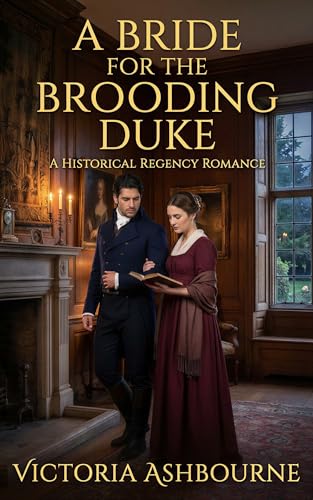
He needs a wife. She needs a roof that won't fall in. A practical marriage, they agree. Nothing more.
Clean, slow-burn Regency romance. Every book stands alone with a happily ever after.
Chapter One In Which a Duke Requires a Wife
The fire at White's had burned down to embers, and nobody had bothered to call for more coal. This was, Julian Hale reflected, a fair summary of most things in his life: something that had once been warm, allowed to die through inattention, while everyone nearby pretended not to notice.
He stood at the window with his brandy, watching a hackney coach splash through the puddles on St. James's Street. November rain streaked the glass. London smelled, as it always did in November, of coal smoke and horse dung and the particular damp rot of a city built on a river nobody in polite society cared to acknowledge. He preferred the smell of Ashworth Park — wet stone and old wood and the faint green memory of gardens — but he had not preferred much about Ashworth Park for some years now, so perhaps it was a moot point.
The club was nearly empty. It was late — past midnight — and the other members had drifted home to their wives and their mistresses and their comfortable beds. Only the three of them remained, as they always remained on the last Thursday of the month, because the last Thursday was their evening. The Reluctant Lords, Marcus had christened them, years ago, with the self-mocking grandeur of a young man who found his own inheritance faintly absurd. Three peers — young, wealthy, and thoroughly inconvenienced by their own privilege — who had not wanted their titles, who had received them through the accidents of birth and death and the stubborn mathematics of primogeniture, and who met regularly to drink brandy and pretend they were still the boys they had been at Eton, before the weight of estates and obligations and the expectations of several hundred dependants had settled on their shoulders like stone.
Behind him, Marcus Thorne was holding forth on something. Marcus was always holding forth on something. It was his primary occupation, followed closely by seducing widows, losing modest sums at cards, and offering unsolicited opinions on Julian's temperament.
"You're brooding again," Marcus announced. He was draped across a leather chair with one leg hooked over the arm, a posture that would have appalled his valet and that Marcus maintained specifically because it appalled his valet. Marcus Thorne, Duke of Ravenscroft, conducted his entire life as an act of mild provocation — beautifully dressed, carelessly brilliant, and possessed of a charm so effortless that it was easy to miss the sharp intelligence working behind it. "That particular brand of brooding where you stare out windows as if the entire city has wronged you personally. It's almost impressive. You've elevated misery to an art form."
"Leave him." Edward Calloway turned a page of the Morning Chronicle without looking up. Edward had the rare gift of stillness. He could sit for an hour saying nothing, and the silence would feel like company rather than absence. "Pemberton came this morning."
Marcus's lazy expression sharpened. "The solicitor? The entail business?"
Julian turned from the window. The light from the dying fire caught the hard planes of his face — the jaw that looked carved from the same grey stone as his Northamptonshire estate, the eyes that had once, according to his mother, been capable of warmth. That had been before his mother left. Before Lydia. Before Thomas. Before the long, careful process of learning to feel nothing at all, which he had undertaken with the same thoroughness he applied to managing his affairs and which had been, on balance, his most successful endeavour.
"The entail requires an heir," he said. "A legitimate one. If I die without issue, everything passes to Gerald."
He said it simply, the way he said most things — without inflection, without emotion, as if the prospect of his family's estate falling into the hands of a dissolute wastrel were merely a problem of accounts rather than the slow collapse of everything his family had built over two centuries. This was how Julian survived: by treating catastrophe as administration. It was, Marcus had once observed, like watching a man calmly reorganise his desk while the building burned around him.
The name landed in the room like something dropped from a height. Lord Gerald Hale, Julian's cousin, had the distinction of being the only man in England who could make a gaming hell look respectable by comparison. He drank. He gambled. He beat his horses and terrorised his servants and had, on one memorable occasion, been ejected from a brothel for conduct the proprietress deemed excessive. The idea of Gerald inheriting Ashworth Park — its tenants, its farms, its two hundred years of careful stewardship — was enough to make Julian's jaw ache from clenching.
"Christ," Marcus said, with feeling.
"Pemberton was blunt. I have until Michaelmas next year. Fourteen months to produce a wife and, ideally, evidence of a forthcoming heir." Julian drained the last of his brandy. It burned going down, which was something. Proof his body still registered sensation, even if nothing else did — though what it registered, these days, was limited to the physical: cold, warmth, the particular ache in his temples that arrived with the third brandy, the dull heaviness in his limbs after a night of poor sleep. The emotional spectrum had been shut down years ago, as deliberately as closing the valves on a steam engine. The machinery was still there. The pressure was still there. But the valves were shut, and the steam went nowhere, and the engine sat idle in the dark of him, rusting by degrees. "After which, the matter ceases to concern me."
"Fourteen months." Marcus sat up properly for the first time all evening. "That's rather brisk, even for you. Marriage generally involves locating a woman who can tolerate your company, which — and I say this with profound affection — is not a brief undertaking."
"I don't require toleration. I require a practical arrangement."
"A practical arrangement," Marcus repeated, as if tasting something unpleasant.
"A woman of good character and modest expectations. Someone who will not confuse the situation with sentiment. Someone who will provide an heir, manage the household, and otherwise leave me in peace."
Edward folded his newspaper with his usual surgical precision. "You've already found someone."
It wasn't a question. Edward had known him twenty years — since Eton, since the age when boys are still transparent despite their best efforts — and could read him with an accuracy Julian found alternately comforting and infuriating.
"Pemberton suggested a name. A vicar's daughter in Hertfordshire. Miss Clara Whitmore. Her father held the living at St. Michael's until his death six months ago. The new incumbent has the parish; she has nothing. Good family, good sense, no fortune, no prospects. Pemberton says she managed the household after her mother's death — ran the parish charities, tended the sick, kept the accounts. She is, by all reports, competent."
"Competent," Marcus said. "What a thrilling basis for matrimony. You might as well propose to a ledger."
"A ledger cannot run an estate."
"A ledger also cannot provide companionship, laughter, comfort, or any of the other things that make marriage distinguishable from a business partnership." Marcus swirled his brandy. "You make her sound like a horse."
"I make her sound like a candidate."
"For what — a position in your household? You could just hire a housekeeper, Ash. They're considerably less trouble than wives and don't require a special licence."
Julian's gaze didn't waver. "A housekeeper cannot give me an heir."
The bluntness of it silenced even Marcus for a moment. The fire popped. Rain hammered the window. Somewhere in the depths of the club, a door opened and closed, letting in a gust of cold air that made the candles gutter.
"And love?" Edward asked quietly. "You've ruled it out entirely?"
The question should have been easy to answer. Julian had been answering it, in one form or another, for seven years — ever since Lydia Ashford had looked at him across a ballroom and he had believed, with the idiotic certainty of a man who did not yet know what the world could do to him, that he had found the woman he would marry. He had courted her properly, in the approved fashion — calls, rides in the park, carefully chaperoned evenings at the opera. He had obtained her father's permission. He had purchased a ring from the same jeweller who had made his grandmother's. He had done everything correctly, because correctness was Julian's religion, his substitute for the faith that other men found in God or drink or the arms of women they should not have been holding.
And then his younger brother Thomas, golden and careless and beloved by everyone who met him, had taken her away in the night. Not cruelly — Thomas had never been cruel. He had come to Julian's study, pale and wretched and unbearably young, and he had said: I love her, Julian. I'm sorry. I love her and she loves me and we're leaving.
And Julian, who had spent twenty-three years mastering himself and could not master this, had looked at his brother's face and said the words he could never retrieve.
You are dead to me. Do not come to this house again.
Three weeks later, Thomas's phaeton had overturned on the Hertford road. A wheel had caught a rut. The horse had panicked. The whole carriage had gone over at speed, and Thomas — bright, laughing, impossible Thomas, who had been running toward a life he believed in — had been thrown against a stone wall and killed instantly. Lydia had survived. She had been pulled from the wreckage with a broken arm and a gash across her forehead and the baby she had not yet told anyone about, which she lost that night.
Julian had not attended the funeral. He had locked himself in his study and had not emerged for three days, and when he did emerge, whatever had been warm in him was gone. Buried with his brother on the Hertford road, alongside the guilt and the rage and the terrible, ineradicable knowledge that the last words he had spoken to Thomas had been a curse that came true.
The words had become prophecy.
"Love," Julian said, and the word came out flat and hard, like a coin dropped on marble. He had loved, once. He had loved Lydia with the careful, constructed devotion of a man who believed that the right woman, chosen for the right reasons, would complete the architecture of his life. He had been wrong. The architecture had collapsed, and the rubble had buried his brother, and Julian had spent seven years clearing it away only to find that what lay beneath was not a foundation but a void.
"Love is a luxury I can no longer afford." He set his empty glass on the mantelpiece. "I leave for Hertfordshire in the morning. If Miss Whitmore is amenable to terms, I'll have a wife by month's end."
"And if she's not amenable?"
"Then I proceed to the next name on Pemberton's list. There is, apparently, no shortage of respectable women whose circumstances make marriage to a duke preferable to the alternatives." He heard himself say it and felt nothing — which was the point, which was always the point. The numbness was not absence. It was armour. It was the cold, smooth surface he presented to the world, and behind it, in the dark, everything he had sealed away still lived: the rage and the grief and the guilt and the terrible, ineradicable memory of Thomas's face in the study doorway, pale and wretched and hopeful, saying I love her, Julian. I'm sorry.
He had not forgiven Thomas. He could not forgive Thomas, because Thomas was dead, and forgiveness required a living recipient, and the dead did not benefit from the absolution of the living. The dead were beyond reach. The dead were stone and silence and the cold ground of a Northamptonshire churchyard where the Hales had been buried for generations, and Julian had not visited the grave in four years because he could not stand before that stone and feel what it required him to feel.
Marcus rose and crossed to the side table, where he poured two fresh brandies with the deliberation of a man composing his thoughts. He brought one to Julian, who took it without thanks — thanks between them had always been unnecessary, one of the quiet foundations of their friendship.
"To duty, then," Marcus said, raising his glass. His voice was lighter now, but his eyes held something that looked, if Julian didn't know better, like concern. "And to the poor woman who agrees to marry you. May she possess the constitution of a saint and the patience of a particularly long-suffering governess."
"To duty," Edward echoed from his chair, more soberly.
Julian drank. The brandy was warm and the club was quiet and outside the rain continued its assault on London, and he allowed himself, for one unguarded moment, to wonder what Miss Clara Whitmore looked like. Whether she was plain or pretty or something in between — not that it mattered, not that any of it mattered, but the wondering came unbidden, like a weed through a crack in pavement. He wondered whether she laughed easily. Whether she had opinions about books, or politics, or the proper maintenance of estate gardens. Whether she would look at Ashworth Park and see what he saw — a monument to failure, a house where everything that mattered had been lost — or whether she would see something else. Something salvageable.
Then he caught himself, and the wondering stopped, and the numbness reasserted itself with the efficiency of long practice. It did not matter what she looked like. It did not matter whether she laughed. She was a solution to a problem, nothing more.
He told himself this firmly, finished his brandy, bid his friends good night, and walked out into the rain without an umbrella, because suffering mild discomfort was still easier than admitting he might want something he couldn't control.
The rain was cold. It soaked through his coat within a minute and plastered his hair to his forehead and ran in rivulets down his collar. He walked. Past the bright windows of the club, past the linkboys with their torches, past the shuttered shops and the empty carriages and the pools of lamplight that the rain turned into mirrors. London at night was a city of reflections — everything doubled, everything distorted, the real and the image so thoroughly intertwined that one could not tell which was which.
He thought about Ashworth Park. About the empty rooms and the dusty library and the garden his mother had planted when she still cared about planting, before she decided that this house and this marriage and this life were a prison she could no longer endure. He thought about the connecting door between the duke's chamber and the duchess's — closed for twenty years, locked for fifteen, the key somewhere in a drawer he had not opened since his father's death.
He would need to open that drawer. He would need to unlock that door. He would need to bring a woman into that house and that life and that silence, and the thought of it — of someone else's presence in those empty rooms, of another voice in those quiet corridors, of the connecting door standing open and the space behind it occupied — made his chest tight in a way he could not attribute entirely to the cold.
He hailed a hackney. He went home — to the townhouse in Mayfair that he kept staffed and maintained and visited as infrequently as possible, because it was the house where he had hosted the engagement dinner for Lydia, where Thomas had stood at the foot of the stairs and raised a glass and said something witty that Julian could no longer remember, and the walls held the echo of that evening the way a bell holds the memory of being struck.
He sat in his study with a glass of water and a headache and the memory of Edward's quiet question — And love? — echoing in the silence.
He did not sleep. He lay in the dark and listened to the rain and thought about Ashworth Park — the rooms he had closed, the gardens he had neglected, the library where Thomas's favourite chair still sat by the window, untouched, preserved in the amber of grief like an insect in a stone. He thought about what it would mean to bring someone into that house. To hear another voice in those corridors. To sit across a breakfast table from a woman he did not know and would not love and could not — would not — fail.
He did not sleep. But he decided.
Back at White's, Marcus had watched him go from the club window. Then he turned to Edward.
"He's going to fall in love with her," Marcus said. "You realise that."
Edward turned another page. "Obviously."
"Should we warn him?"
"Would it make any difference?"
Marcus considered this. "No," he admitted. "No, I don't suppose it would." He settled back into his chair, stretched his legs toward the dying fire, and smiled the smile of a man who had no intention whatsoever of marrying anyone, ever, under any circumstances.
It was, as smiles go, impressively certain.
It would not last.
Want to know what happens next?
Keep reading on Amazon. A Bride for the Brooding Duke is free to read in Kindle+.
Keep reading on AmazonOr start with a free Christmas novella, sent to your inbox.
Get the free novellaExcerpt from A Bride for the Brooding Duke by Victoria Ashbourne. © 2026 Victoria Ashbourne. All rights reserved.